
Taylor County Court Records After Arrest
A Taylor County arrest can create several separate records. The jail booking record is the custody record. The sheriff or arresting agency may also have an arrest or incident record. The court record starts when the charge is filed in the Iowa court system. Taylor County Attorney Mike Wells is the county attorney listed by the county, and that office reviews law-enforcement reports and decides what charges to pursue in state court.
The court record can differ from the jail record. A booking charge is an arrest-level allegation or warrant basis. A formal court charge can be amended, reduced, dismissed, enhanced, or replaced after prosecutor review. Custody status can also change before a case is resolved. For current custody and booking details, use Taylor County jail inmate records. For booking photos, use the Taylor County jail mugshots page. For filed charges, hearing dates, case numbers, and dispositions, use court records.
Iowa Courts Online is the public electronic docket starting point for Taylor County criminal cases.
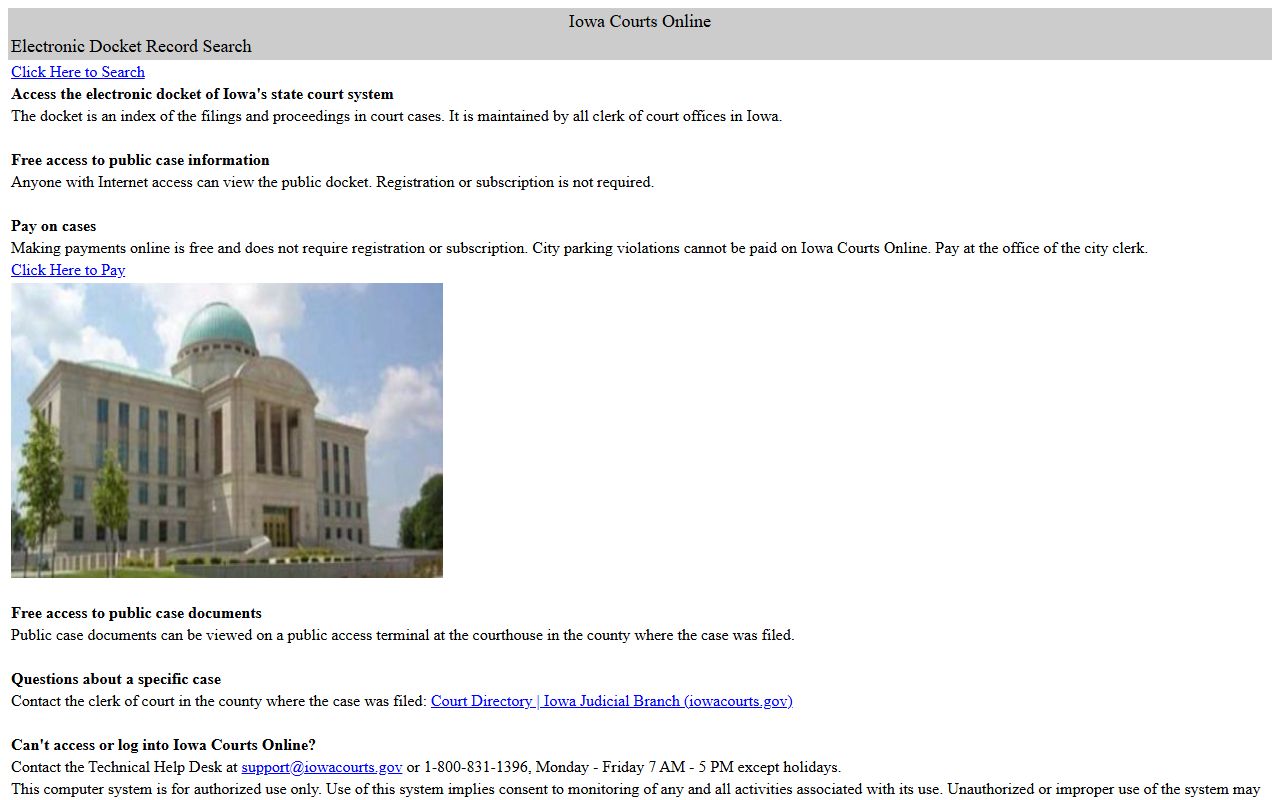
The court portal is statewide, so narrow the search to Taylor County when the interface allows county filtering.
Find Court Records After Arrest
Iowa Courts Online is the main public search route for criminal case records after a Taylor County arrest. The court index is not the same as the jail roster. A new arrest may be in sheriff custody before the case appears online, and older or sealed matters may require direct clerk contact. The Taylor County Clerk of Court page lists Jackie Saville as clerk, with office hours during the weekday courthouse schedule.
- Get the full name, arrest date, and any case, citation, warrant, or complaint number from the sheriff, booking paperwork, or court notice.
- Search Iowa Courts Online by name and narrow to Taylor County if the search action permits county filtering.
- Open the case index and compare the booking charge with the formal court charge, statute, case number, and next hearing date.
- If the arrest is too new for an online case result, call the Taylor County Clerk of Court at 712-523-2095.
- If the case is old, archived, sealed, or expunged, ask the clerk what public access remains available.
The clerk is the correct route for court-file questions. The sheriff can answer current custody and local booking questions, but the jail does not decide final court charges or interpret case dispositions.
Taylor County Court Search Fields
The static court pages reviewed showed Iowa Courts Online as a statewide public case index and an action-selection page with limited-field searches. The exact live form can vary by action, but the research supports the following field inventory for readers preparing a Taylor County court records search after arrest.
| Field or Action | Type | Use | Notes |
|---|---|---|---|
| Search type or report action | Menu or link | Select the public case-search path | Required before entering case criteria |
| Case name or party name | Text | Search by defendant name | Use spelling variants when needed |
| Case number | Text | Go straight to a known case | Useful if obtained from the jail, clerk, complaint, or citation |
| County | Dropdown if available | Narrow to Taylor County | Cases from another county will not be Taylor County cases |
| Case type | Dropdown if available | Limit to criminal or traffic records | Availability depends on the selected search action |
Charges Filed After Arrest
After a Taylor County jail arrest, a court case may begin with a complaint or move into a prosecutor-filed charging document. Iowa felony practice commonly uses trial information filed by the county attorney rather than a grand-jury indictment in routine cases. An indictment remains a possible charging route, but it is less common in ordinary county prosecution. Minutes of testimony may also be associated with a trial information, though access can be limited or redacted.
| Document | Who Uses It | Plain-English Meaning |
|---|---|---|
| Complaint | Law enforcement or prosecutor | A sworn allegation or early charging paper that can start a criminal case. |
| Trial information | County attorney | The formal Iowa prosecutor-filed charging document, often used in felony procedure. |
| Indictment | Grand jury | A grand-jury charging document, less common than prosecutor-filed information in everyday cases. |
| Amended charge | Prosecutor or court process | A changed charge after evidence review, plea negotiation, or court action. |
Taylor County Charge Status
Charge status tells what has happened to a filed allegation. It does not always explain current custody. A person can be released while a charge is pending, held on another case after a local charge is dismissed, or transferred to Iowa DOC after sentencing. Read each charge line and case event rather than assuming the first booking entry remains the final charge.
| Status | What It Means |
|---|---|
| Pending | The charge or case has not been resolved. |
| Amended | The filed charge changed after prosecutor or court action. |
| Reduced | A lesser charge replaced or resolved the original allegation. |
| Dismissed | The charge ended without a conviction on that count. |
| Acquitted | The defendant was found not guilty. |
| Convicted | Guilt was established by plea or verdict. |
| Deferred judgment | Judgment is deferred under conditions and may be treated differently if completed. |
Bond After Taylor County Arrest
Bond is court-driven. The jail can explain local posting logistics after bond is set, but the court order controls release conditions. The research did not locate a Taylor County-specific bond fee schedule, online jail payment portal, or bond-hours page. Confirm the current instruction with the sheriff for custody and with the clerk for court-file payment or case questions.
| Bond or Release Type | How It Works |
|---|---|
| Cash bond | Money is posted under court instructions. |
| Surety bond | A surety bond company posts bond if allowed by the court order and Iowa practice. |
| Unsecured bond | The person promises to pay if they fail to appear. |
| Personal recognizance | Release is based on a promise to appear, often with conditions. |
| No-bond hold | The current court or warrant status does not allow release by posting money. |
| Detainer or hold | Another agency may prevent release after local bond is posted. |
Warrants and Court Records
No official Taylor County active warrant list, most-wanted list, warrant search form, or sheriff app warrant feature was located. Warrant questions should move through the sheriff for local law-enforcement status and the clerk for court-case status. A bench warrant may appear in a case docket, but public case systems may not display every operational detail officers use for safety or service.
Warrant types matter. An arrest warrant authorizes arrest on a charge. A bench warrant is often issued by a judge for failure to appear or another court-order issue. A search warrant is not a custody record. A fugitive warrant may involve another jurisdiction. If a person is arrested in Taylor County on an out-of-county or federal warrant, the local jail may have only a temporary hold or transport role.
Charges vs Convictions
An arrest and charge are not proof of guilt. Taylor County court records after a jail arrest can show allegations that later change or end without conviction. The useful reading habit is to compare the docket events, current charge status, disposition, and sentence if one exists.
| Question | Charge | Conviction |
|---|---|---|
| Stage | Accusation filed in a case | Guilt established by plea or verdict |
| Can it change? | Yes, it may be amended, reduced, or dismissed | Yes, but only through later court action such as appeal or post-judgment relief |
| Custody effect | May affect bond or hold status | May lead to jail, probation, prison, fine, or other sentence |
| Best source | Iowa Courts Online and clerk | Iowa Courts Online, clerk, DCI check, or DOC after prison sentence |
Sealed and Expunged Records
Iowa Code Chapter 901C and section 901C.3 address expungement for eligible criminal records. Expungement can make eligible court records confidential from public access, but it should not be described as a promise that every jail record, agency copy, or reposted image disappears from every place it has traveled. The clerk is the right office for court-file access questions, while the sheriff is the local custodian for sheriff and jail records.
| Issue | Sealed or Confidential | Expunged |
|---|---|---|
| Public access | Restricted by law or court order | Eligible record becomes confidential from public access under the statute |
| Where to ask | Clerk for court records, custodian for agency records | Clerk and court process |
| Limits | Some officials may retain access | Does not erase every third-party copy automatically |
Iowa Criminal History Checks
A DCI criminal-history background check is different from a Taylor County court docket and different from a live jail custody check. Iowa.gov says criminal-history requests can be made online or in person and cost $15 per check. The request uses the person's first and last name and date of birth, with gender, Social Security number, and middle name helping the search. Iowa.gov also notes that Iowa DCI records are Iowa records and do not include other states, FBI records, or federal convictions.
Important: Do not use informal inmate or court searches for credit, employment, tenant, insurance, or other FCRA-covered screening.
Restricted Court Records After Arrest
Iowa Code Chapter 22 supports public access to records unless an exception applies, but not every arrest-related record is fully open. Iowa Code 22.7(5) protects many law-enforcement investigative reports, while immediate facts and circumstances such as date, time, and location may be treated differently unless disclosure creates a listed risk. Juvenile records, sealed or expunged cases, medical information, protected victim or witness information, and intelligence data may be withheld or redacted.
When a public case result does not appear, it may be too new, filed in a different county, sealed, expunged, confidential, archived, or listed under a spelling variation. The Taylor County Clerk of Court is the practical next step for case-file access, and the sheriff is the practical next step for local booking or custody records.
Public Record Search
Sponsored Results